
Have you ever witnessed trout rise to the surface and wondered if they are skimming the water for any drifting insects? Well, it turns out that you do not have to make a choice between a dry fly and a nymph; it is possible to fish both simultaneously with a dry-dropper rig.
Anglers will find this technique particularly valuable when fishing streams and riffles of Montana Rivers where trout are feeding at varying depths. At Fish Tales Outfitting, the owner, who is also a licensed guide, Michael Stack has over 30 years of experience helping anglers adapt to the different techniques of fishing. Here is a guide to setting up and fishing a dry-dropper rig competently.
What Is a Dry-Dropper Rig in Fly Fishing?
A dry-dropper rig means you are going to have two flies on the same leader:
- Dry fly: A fly that floats and tricks the fish that are eating insects. Also, it serves as a visual strike indicator.
- Dropper nymph: A fly that sinks and imitates aquatic insects that the fish feed on.
There is huge flexibility with this method. Even if a fish does not take a dry fly, there are chances that the fish will take the nymph. If fish kills the nymph, the dry fly will be dipping, resting, or moving around.
We advise anglers to observe the water conditions and fish behavior instead of believing that one fly is sufficient everywhere.
How to Set Up a Dry-Dropper Rig
You will not require sophisticated equipment to begin. Collect a floating fly line, a tapered leader, some tippet, a dry fly that will float, and an appropriate nymph.
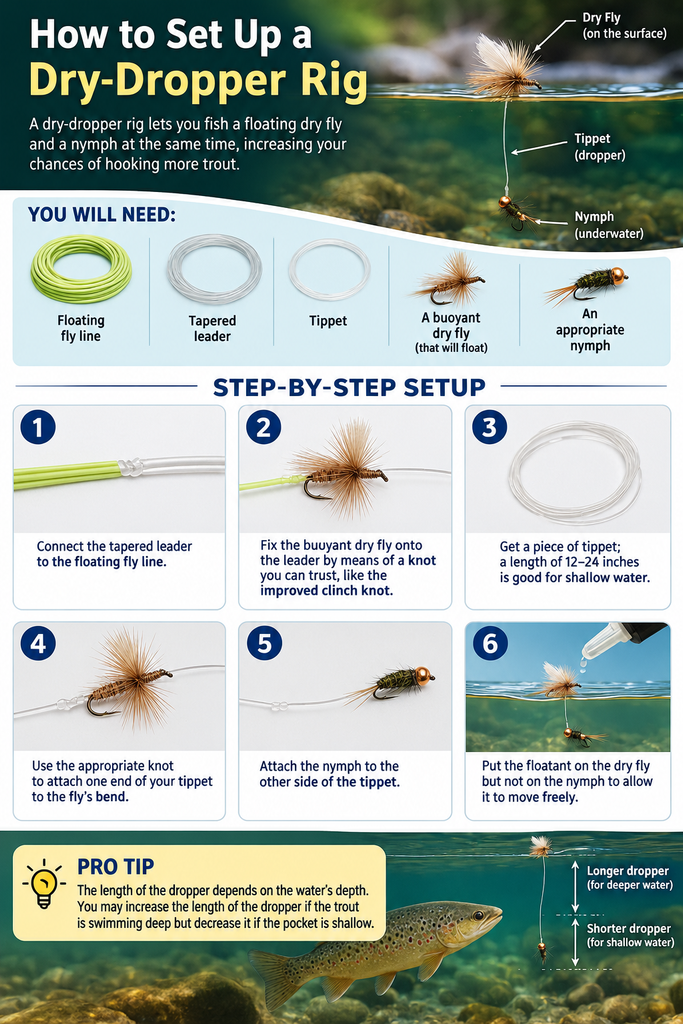
These are the steps to follow:
- Connect the tapered leader to the floating fly line.
- Fix the buoyant dry fly onto the leader by means of a knot that you can trust, like the improved clinch knot.
- Get a piece of tippet; a length of 12-24 inches is good for shallow water.
- Use the appropriate knot to attach one end of your tippet to the fly’s bend.
- Attach the nymph to the other side of the tippet.
- Put the floatant on the dry fly but not on the nymph to allow it to move freely.
The length of the dropper depends on the water’s depth. You may increase the length of the dropper if the trout is swimming deep but decrease it if the pocket is shallow.
How to Tie a Nymph to a Dry Fly
Perhaps the most straightforward technique one can learn is connecting the nymph to the bend of the hook of the dry fly.
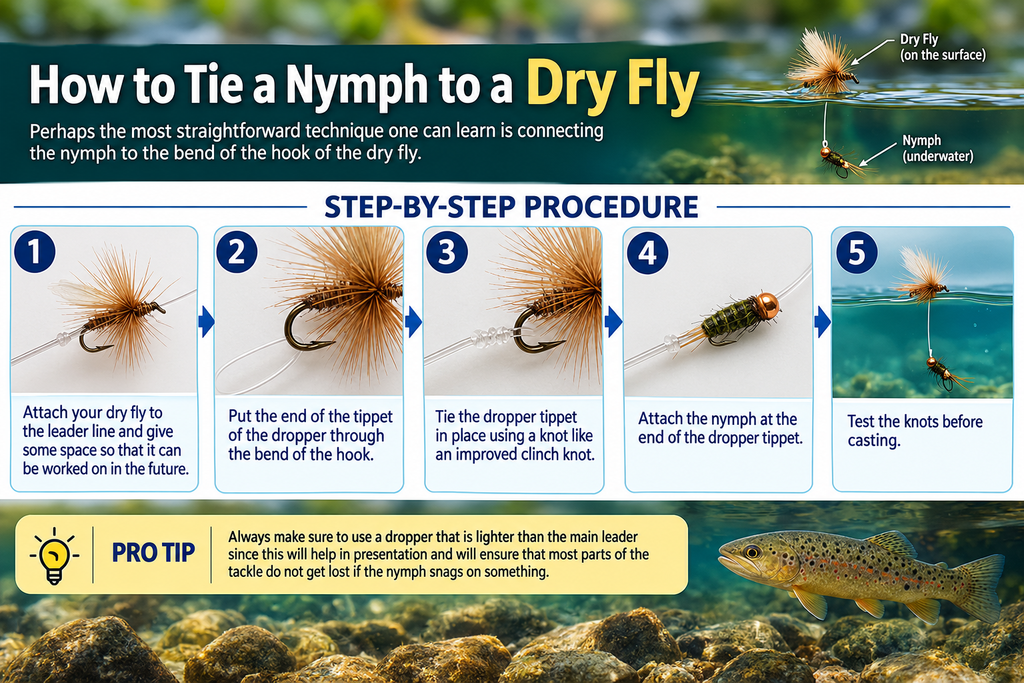
Below is the step-by-step procedure for the task:
- First step: Attach your dry fly to the leader line and give some space so that it can be worked on in the future.
- Second step: Put the end of the tippet of the dropper through the bend of the hook.
- Third step: Tie the dropper tippet in place using a knot like an improved clinch knot.
- Fourth step: Attach the nymph at the end of the dropper tippet.
- Fifth step: Test the knots before casting.
Always make sure to use a dropper that is lighter than the main leader since this will help in presentation and will ensure that most parts of the tackle do not get lost if the nymph snags on something.
How to Tie a Dropper Rig for Trout: Choosing the Right Flies
The ideal combination is determined by the trout’s diet and your dry fly’s weight. Some good combinations include:
- The Chubby Chornobyl and Pheasant Tail Nymph: This is good for fishing because you’re using an insect imitation underwater while also using a buoyant dry fly.
- The Elk Hair and a small nymph: This is good when caddisflies are in season because the trout may go for food that is located underwater.
- The foam hoppers and the bead-head nymph: This is appropriate for the hot weather since there is a lot of food available from terrestrial insects.
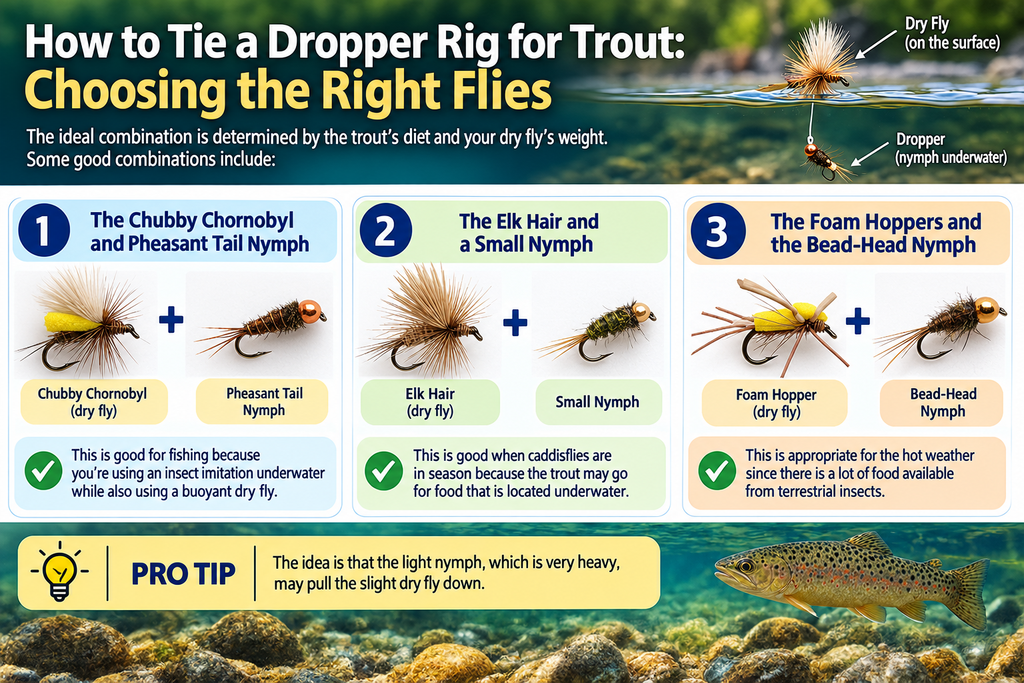
The idea is that the light nymph, which is very heavy, may pull the slight dry fly down.
How to Fish a Dry-Dropper Rig for Better Results
Once your rig is assembled, presentation matters as much as fly selection.
- Cast slightly upstream or across the current, aiming for a natural drift.
- Watch the dry fly closely for pauses, sudden dips, sideways movement, or other unusual behavior.
- Mend your line when needed to reduce drag and keep both flies moving naturally.
- Adjust the dropper length according to the depth where trout are holding.
- Use controlled casts to reduce tangles, especially in windy conditions.
When a trout takes the nymph, the dry fly may act as your first visible clue. If the dry disappears or moves unnaturally, lift the rod smoothly to set the hook.
Learn Dry-Dropper Fishing With FishTales Outfitting
Reading water, choosing the right flies, and adjusting your presentation are skills that develop with practice. FishTales Outfitting helps anglers experience Montana’s renowned trout rivers while learning techniques suited to their experience and goals.
Whether you are new to fly fishing or refining your approach, fishing with an experienced guide such as Michael Stack can help you better understand river conditions, fly selection, and effective presentations.
Conclusion: Master the Dry-Dropper Rig for Fly Fishing
A dry-dropper rig for fly fishing is a straightforward way to target trout feeding on the surface and below it. With a buoyant dry fly, a properly sized nymph, and the right dropper length, you can adapt to changing conditions without constantly rebuilding your setup.
Practice the knots, watch your drift, and make adjustments based on what the water tells you. For anglers ready to develop their skills on Montana’s rivers, FishTales Outfitting offers guided fishing experiences backed by Michael Stack’s decades of experience.
Frequently Asked Questions
1. How long should a dry-dropper leader be?
A nine-foot tapered leader is a common starting point. Adjust the overall setup and dropper length to suit the water depth, casting conditions, and fish behavior.
2. Can beginners use a dry-dropper rig?
Absolutely. It is a useful way to learn how trout respond to surface and subsurface flies. Start with a short dropper and a buoyant dry fly to make casting easier.
3. What is the best nymph for a dry-dropper setup?
Pheasant Tail, Hare’s Ear, and small bead-head nymphs are popular choices. Match your selection to local insect activity, water depth, and current speed.
4. Why does my dry fly keep sinking?
Your nymph may be too heavy, or your dry fly may lack sufficient buoyancy. Try a larger foam-bodied dry, a lighter nymph, or fresh floatant where appropriate.
5. When should I use a dry-dropper rig for trout?
Try it when trout may be feeding both at the surface and below it, in riffles, pocket water, and smaller streams. For deeper water, a dedicated nymphing setup may be more effective.
6. Where can I learn dry-dropper fishing in Montana?
Contact Michael Stack at 406.451.2074 to explore guided fishing trips and learn more about fishing Montana’s renowned trout waters.